


Treasury Report · November 2026. Data as of 10/26/2026. USD values for ETH holdings use an ETH price of $2,253.47 (10/31/2026).
Key Takeaways
Staking yield has halved. Lido’s yield fell from a 4.5% average in 2022 to 2.2% today as ETH staked grew about 3.5x to 45.2M; every major liquid staking token now pays 2.1% to 2.3%.
Treasuries hold a meaningful share. Public companies own 8.03M ETH (6.6% of supply) and US spot ETFs about 6.1M (5.0%); across the 28 treasuries we track, about 74% of the ETH whose deployment is visible is staked.
Little beats staking in ETH terms. Lending (1.3%) and LPing (1.2%) pay less than staking (2.2%); only first-loss cover (4.8%) and covered calls (7.6%) pay more, and each adds a different risk.
Security is the largest single concern. 328 hacks so far in 2026 vs 148 in all of 2025, with $8.78B stolen vs $2.72B, including the $6.36B Binance theft on 10/29/2026.
Holding ETH is a currency position. Since 11/2018 a one-year hold returned anywhere from -92% to +2,142%, with a +14% median; 45% of one-year periods lost money.
Holders want more than staking. Every service provider we surveyed called staking yield “a base, but not enough on its own”; together with the treasury companies we spoke to, participants hold or manage a combined 7.1M ETH ($16B). Governance, not yield, is the main blocker.
Foreword
By David Walsh, Co-founder, Ethereum Institutional
Over the past few years, ETH has become a balance-sheet asset for a wide range of organizations. Public companies, funds, and crypto-native entities now hold it in size, and most of them stake it. Staking has given institutions something few assets offer: a native, protocol-level return that has created new revenue lines for holders. With staking yields compressing, the question has moved on to what else these treasuries can do with their ETH.
This report by Kairos Research in partnership with the Golem Foundation is a useful guide to those choices. Golem Foundation has managed its own ETH treasury since 2019, and the report draws on that practical experience. It looks at the various options open to ETH holders and measures their returns, and is open about the risks involved, including what ETH’s volatility means for organizations that pay their costs in dollars.
At Ethereum Institutional, we spend much of our time with banks, asset managers and companies working through these questions, alongside broader ones on tokenization and onchain settlement on Ethereum. Most of those conversations happen privately, and good public research like this helps move them forward.
The first phase of institutional adoption was about whether to hold ETH. The next is about putting it to work well, and this report is a practical resource for that.
Introduction: Where the Question Stands
Treasuries now hold a meaningful share of all ETH. Public companies own 8.03M ETH, 6.6% of supply; US spot ETFs hold about 6.1M ETH (5.0% of the supply); and DAOs and foundations hold hundreds of thousands more. Much of it is staked, but very little goes further: across the network, 37% of all ETH is staked, while only about 3% is lent on lending protocols and 2% is restaked. The question has shifted from “should we hold ETH on our balance sheet?” to “what is the best way to position our ETH exposure?”
While staking used to be the easy answer, Lido’s yield has halved since 2022, from a 4.5% average that year to 2.2% today, as the amount of ETH staked across the network has grown about 3.5x over the same period.
That raises the question at the center of this report: is staking alone enough for a large ETH treasury? What other options do some of ETH’s largest holders have to make the asset productive? Out of all of the treasury companies, service providers and asset managers that we spoke to or surveyed, nearly all of them responded that it was time to look for yield beyond staking. While the sample size was small, participants and respondents include some of the largest companies in the space and hold or manage a combined 7.1M ETH ($16B).
The following report looks into the data to understand which institutions are putting ETH onto their balance sheet, what they are doing with it and what their thesis is for the asset. It is organized as follows:
Where ETH sits: who holds the supply, and how the largest treasuries and companies deploy their ETH
Staking and beyond: the onchain options for making ETH productive, from staking and restaking to lending, first-loss cover and covered calls, all measured in ETH
The tradeoffs: the smart contract, credit, liquidity, slashing and operational risk behind each option, so every treasury can make informed decisions based on their own short-term capital needs
ETH’s performance: ETH’s best, worst and median years. Most organizations with real burn rates pay their bills in USD, so holding ETH is also a currency position. We explore ETH’s volatility, but also how it has matured over the years
The stablecoin comparison: yields from Aave lending, the Ethena basis trade, OnRe reinsurance, USDai GPU lending and tokenized T-bills. They are the benchmark in dollars, and a sign of how much yield applications on Ethereum and other networks now pass directly to their users
Holder perspectives: the thesis that demand for ETH will follow stablecoins, tokenized assets and L2s onchain, and what the data says so far
Part 1: Where ETH Sits Today
To better understand ETH yield opportunities and what the top holders are looking for, it helps to know where the supply sits. Over a third of the supply is staked and public companies now hold 6.6%, worth about $18.1B at $2,253.47 per ETH (10/31/2026). DAO and foundation treasuries hold a small slice, and most of it is staked.
Over a third of ETH is staked
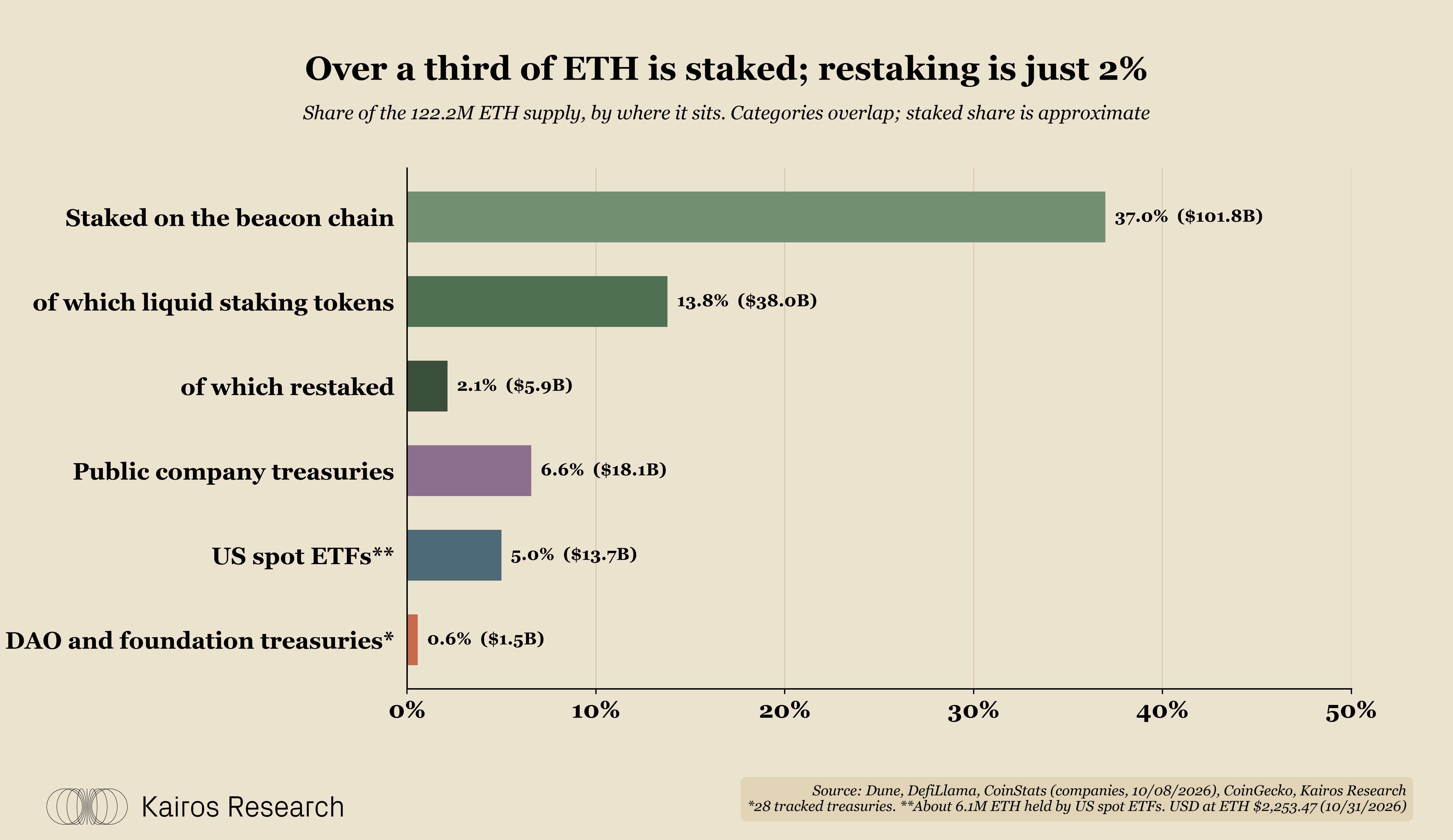
About 45.2M ETH (37% of supply) is staked and 16.8M of it sits in liquid staking tokens.
Public companies hold 8.03M ETH, led by Bitmine (6.05M) and Sharplink (0.89M), and US spot ETFs about 6.1M (5.0%). The DAO and foundation treasuries we track hold 0.6% of supply.
How treasuries hold their ETH
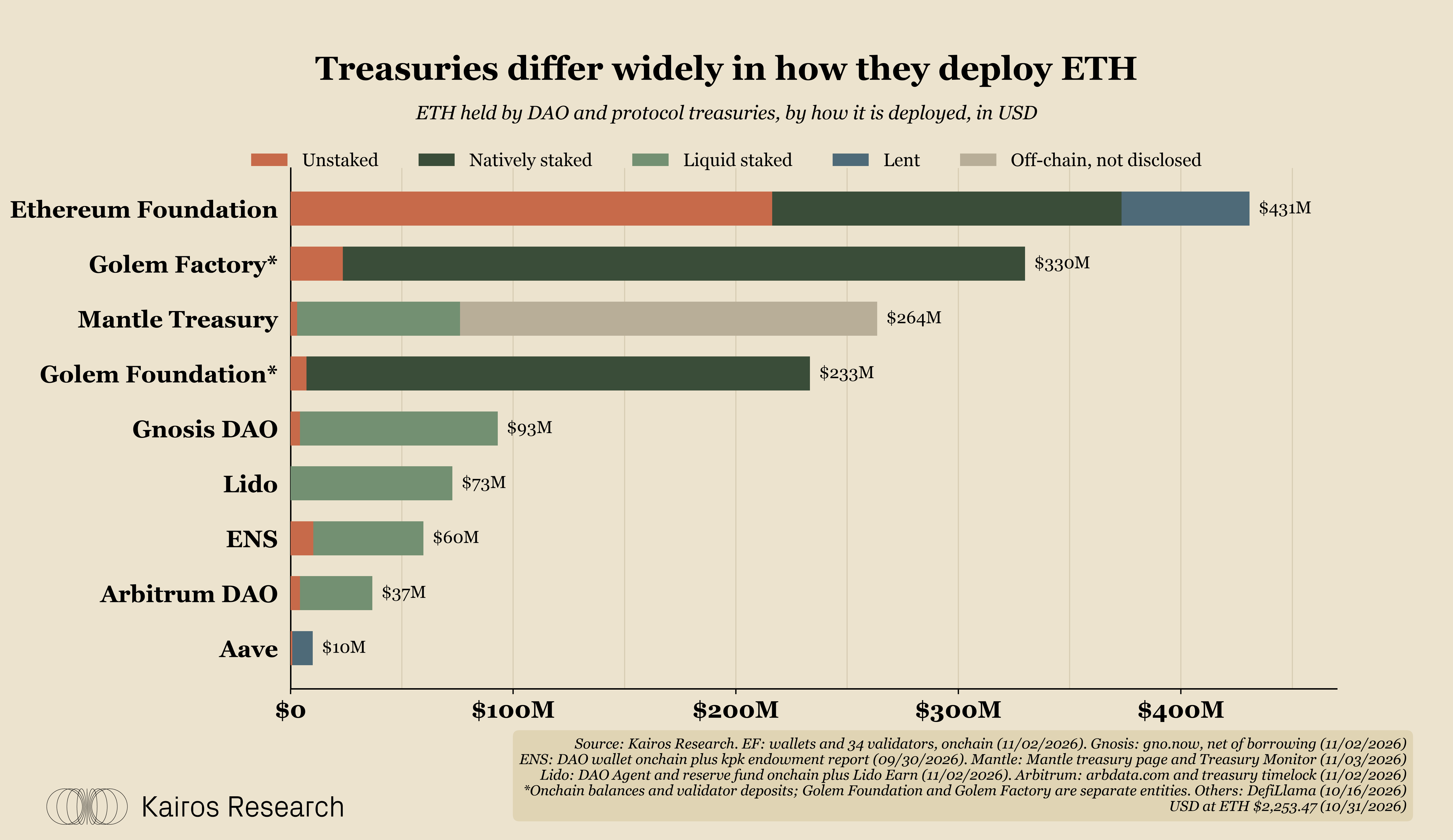
Across the 28 treasuries we track, about 74% of the ETH whose deployment is visible is staked (51% natively, 23% through liquid staking tokens), about 21% sits unstaked and about 5% is lent; another 12%, mostly Mantle’s, is held off-chain and its deployment is not disclosed (figures are rounded).
Practice varies: Lido, Gnosis and the Golem Foundation stake 95% or more (Gnosis also borrows about $25M of ETH against its staked ETH), Arbitrum stakes 89% and ENS 83%, Mantle stakes nearly all the ETH it holds onchain but keeps about 71% of its ETH off-chain without disclosing how it is deployed, and the Ethereum Foundation, the largest at about 191K ETH, stakes 36%, lends 13% and keeps about half unstaked. At 2.2%, every 100,000 idle ETH forgoes about 2,200 ETH a year, a quiet dead-weight cost of leaving ETH unstaked.
“We’ve had a strong conviction in Ethereum since day 1. At Golem Foundation, we’ve been an ETH-long treasury since our inception in 2019, and have been staking and running our validators for years. Staking has played a key role in our sustainability, and has enabled 5,273 ETH in funding via Octant for users and Ethereum’s best teams. I believe we are past the point of only holding and staking ETH, we need an ETH denominated Ethereum economy. With staking yields declining, we recognize relying on them alone limits what we can deliver. We are committed to diversifying into low-risk, ETH-long instruments and are actively exploring how ETH treasuries can be productively put to work.”
Julian Zawistowski, Founder & Executive Director, Golem Foundation
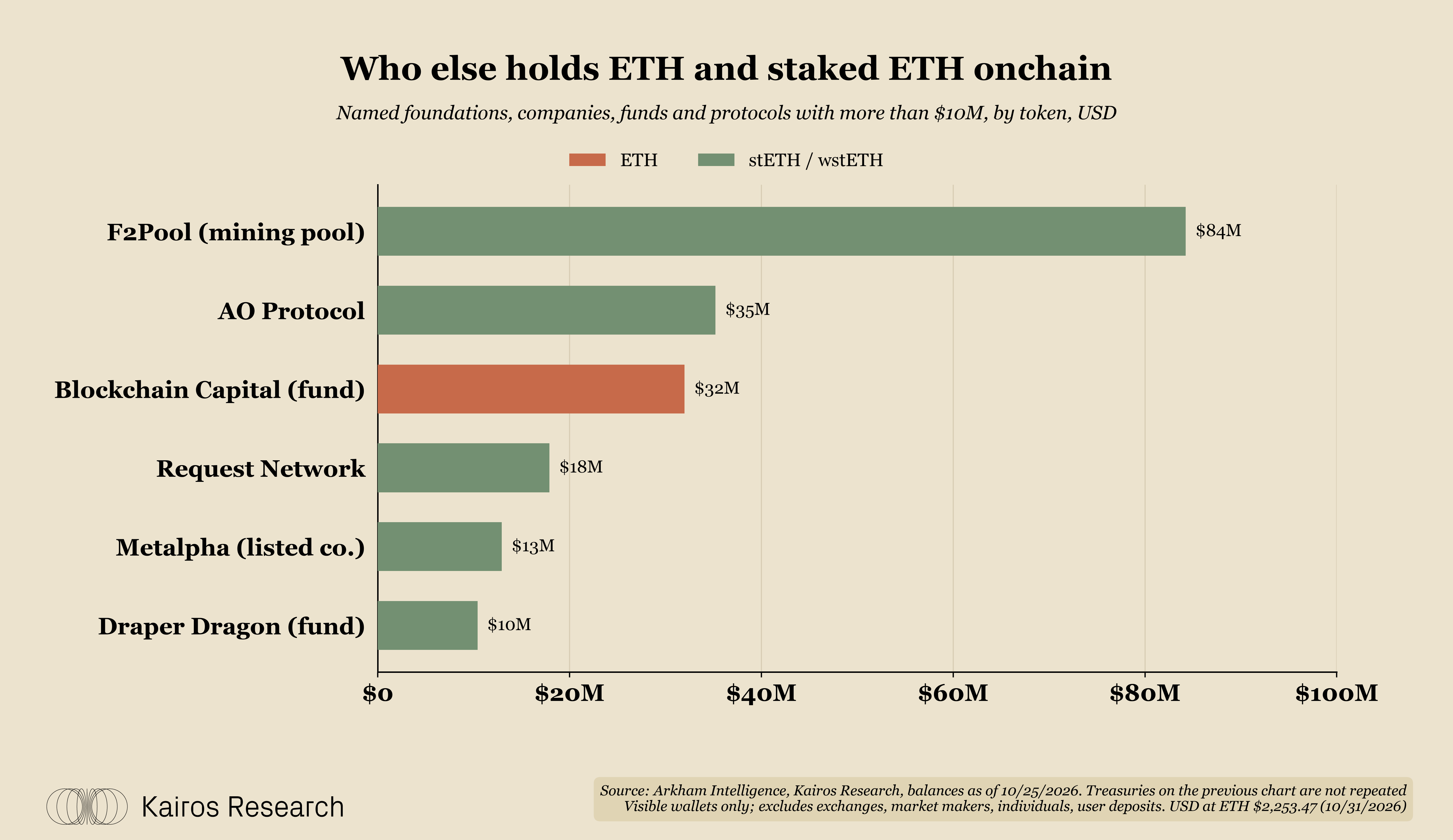
Onchain data supports the idea that protocols, investment firms and operating companies have all built and sustained significant exposure to ETH. The Arkham data below is just a small peek into the world of ETH treasuries. We know for certain that L2s and exchanges also have significant ETH exposure, including the Arbitrum DAO, which holds about 16.3K ETH (roughly $37M).
Who else holds ETH and staked ETH onchain

How the largest corporate holders deploy ETH
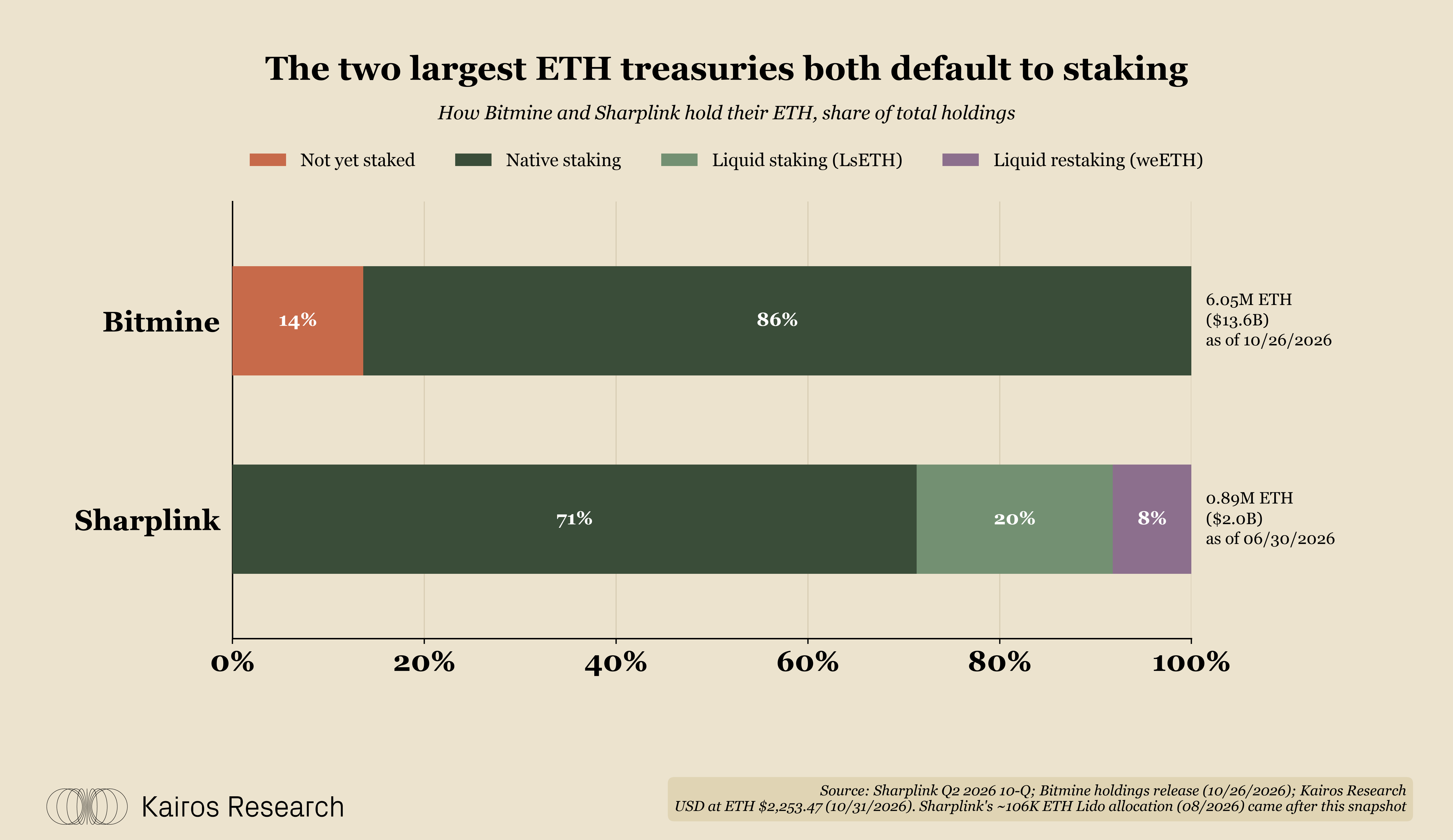
Bitmine has staked 5.23M of its 6.05M ETH (86%) through native validators rather than liquid staking tokens, largely via MAVAN, the validator network it built after buying operator Pier Two in 03/2026. It reports a 2.58% yield, delivering about $318M a year in staking revenue, and staking was 98% of its last quarter’s revenue. It discloses no restaking, lending, LP or options positions.
Sharplink has a different portfolio setup: maintaining about 2/3 native staking and 1/3 liquid staking. Since inception, it has deployed $200M worth of ether.fi’s weETH to Linea and EigenCloud, placed about 106K ETH ($200M) with Lido as wstETH, and put $100M of staked ETH into a Galaxy-managed onchain yield fund. Collectively, it has earned 28,351 ETH in staking rewards to date (09/29/2026).
“As the world’s largest corporate holder of ETH, Bitmine has added to its position every week since launching the treasury strategy in June 2025, and we are approaching our target of 5% of total supply. Through MAVAN, we stake our own ETH alongside our customers’ ETH and other digital assets, securing the network and providing the critical infrastructure services for the ecosystem. We also invest in commercializing the Ethereum ecosystem in ways we expect to create value for shareholders, from ‘Moonshot’ positions such as Beast Industries and Eightco Holdings to recent Ethereum Foundation spinouts including Ethlabs, Ethereum Institutional and EthSystems, each launched to help the network support institutions at scale.”
Young Kim, COO & CFO, Bitmine Immersion Technologies, Inc.
“Over the last year, we’ve seen stablecoins, tokenized assets, DeFi and AI agents all land on Ethereum at the same time, creating an economic big bang that will deliver a period of unprecedented growth. As the world’s second-largest corporate holder of ether, we look toward 2027 as an opportunity to utilize our balance sheet of permanent capital to accelerate the transition through targeted investments and reward shareholders at the same time. We stake our ETH to help secure the network, put the first liquidity into new protocols, and help fund groups like ETHLabs, Ethereum Institutional and ETH Systems so Ethereum is ready for the people and institutions coming next.”
Joseph Chalom, CEO, Sharplink
Part 2: The Vanilla Staking Baseline
Staking is the default yield on the Ethereum network and the benchmark every other strategy has to beat. That benchmark is falling, and restaking has not yet become a meaningful layer of additional yield.
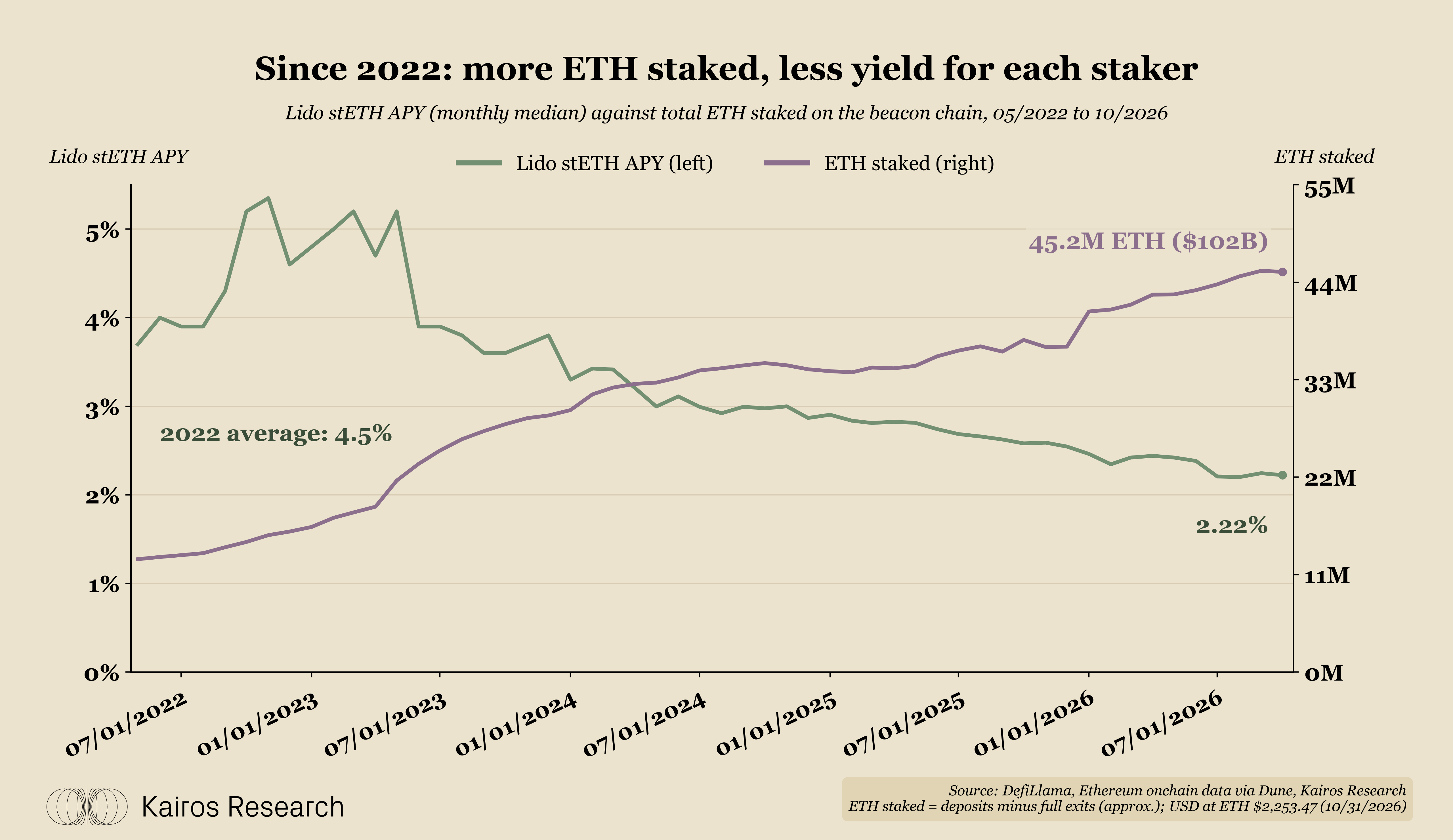
Lido’s yield has halved, from a 4.5% average in 2022 to 2.2% today, and every major liquid staking token now pays 2.1% to 2.3%.
ETH staked has grown about 3.5x since 2022, from a 12.9M average that year to 45.2M. The more ETH that gets staked, the lower the network yield, so further compression is possible.
Restaking has not yet delivered significant yield
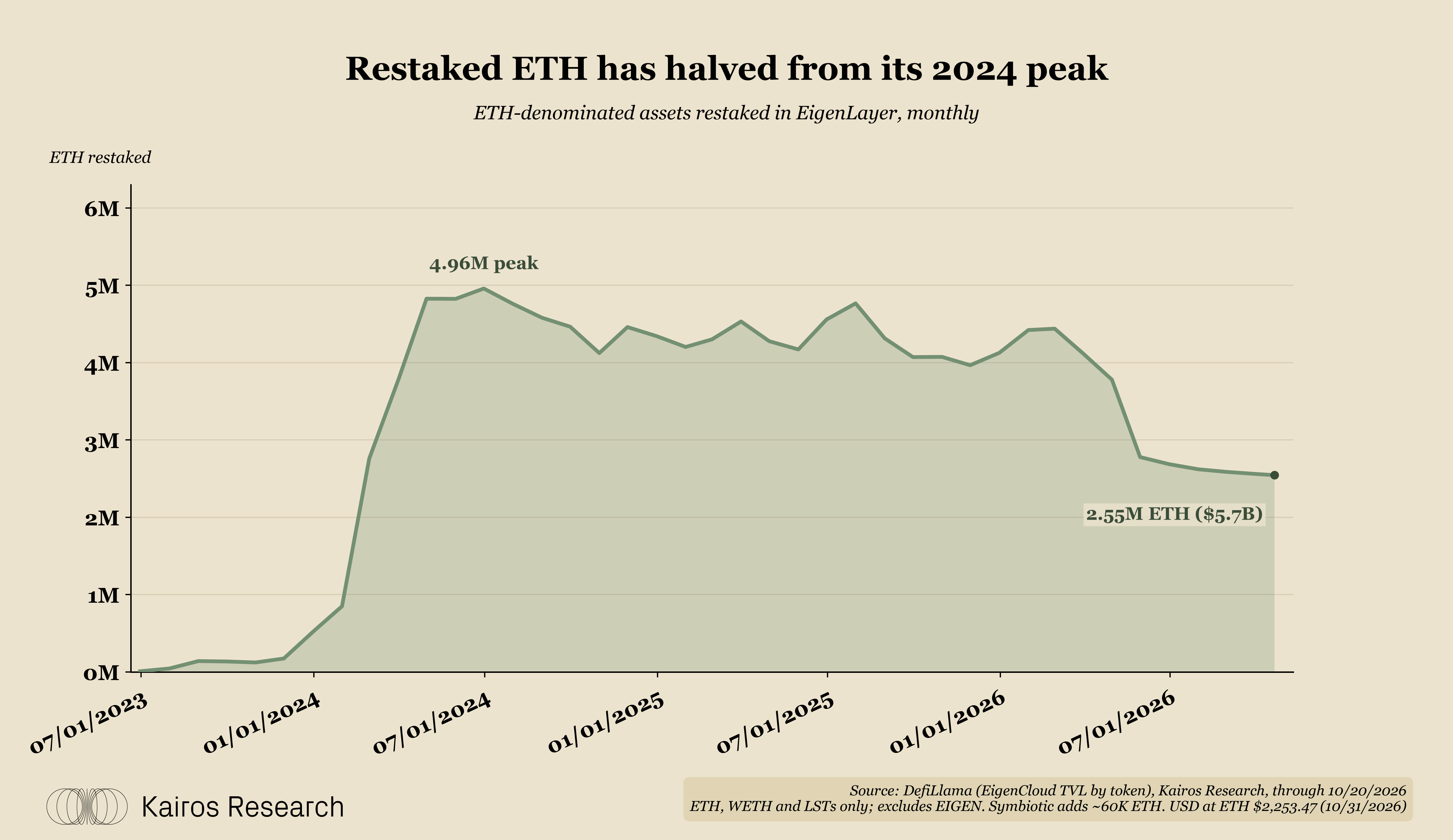
2.6M ETH is restaked (2.1% of supply), almost all in EigenLayer, down from about 5M in mid-2024. Symbiotic holds about 60K ETH.
Liquid restaking tokens pay 2.2% to 2.7% vs 2.2% for plain staking, so the extra slashing and liquidity risk earns little beyond points and EIGEN incentives.
Much of the extra yield restaking once offered came from EIGEN airdrops, points programs and other token incentives rather than fees paid by the services using restaked ETH. As those incentives wound down, the premium over plain staking largely disappeared, and restaked ETH roughly halved from its 2024 peak.
Part 3: Beyond Staking, Measured in ETH
For an ETH treasury, the right test is whether a strategy grows the stack of ETH, not necessarily just its dollar value. The examples below have very different liquidity, risk and return profiles that may fit into different treasury strategies.
The ETH yield stack
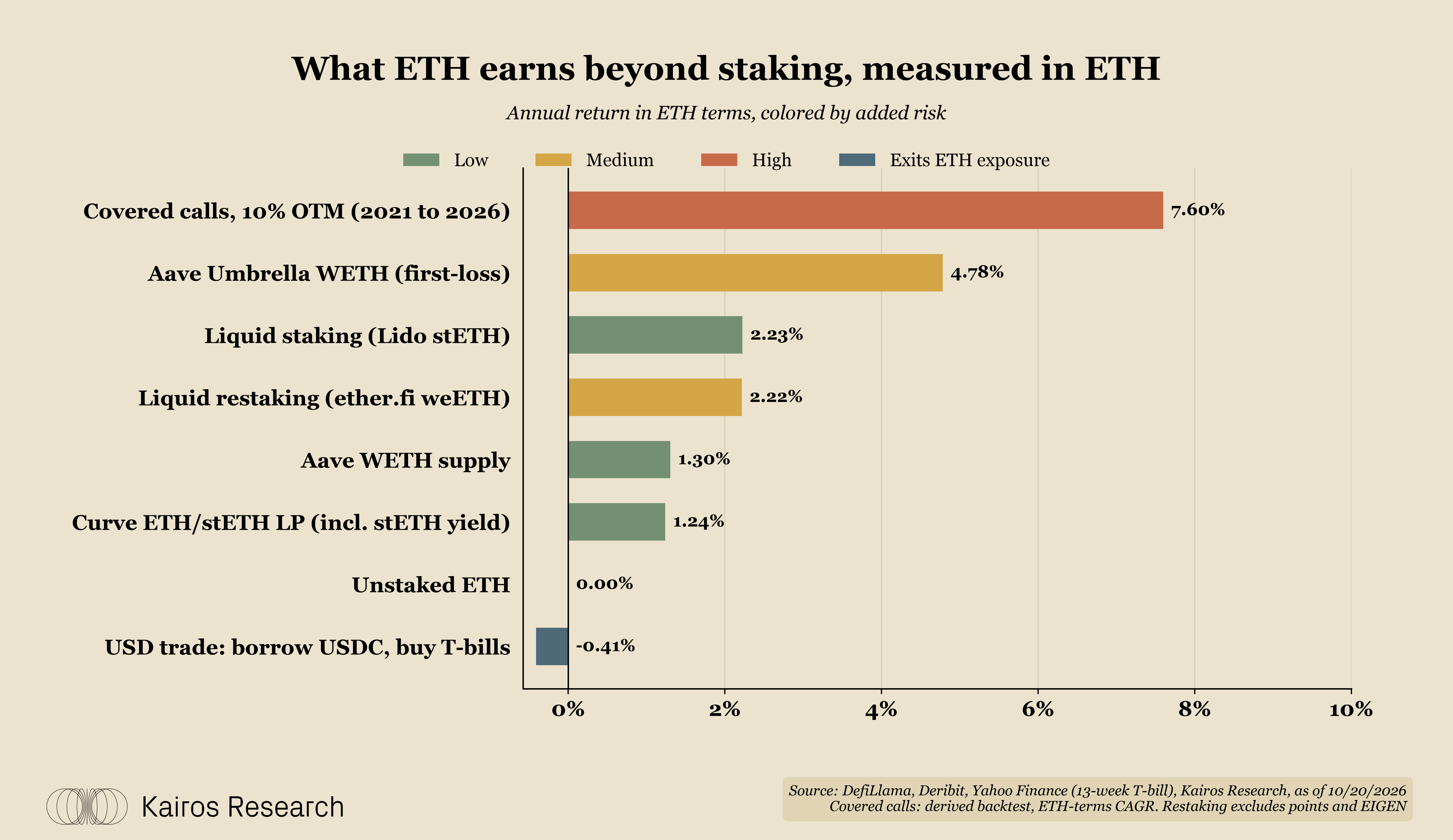
In ETH terms, lending (1.3%) and LPing (1.2%) pay less than staking (2.2%). Only first-loss cover (4.8%) and covered calls (7.6% a year since 2021, measured in ETH) pay more, but each adds a different risk.
Basis and T-bill trades are USD returns that remove ETH exposure. Borrowing USDC at 4.50% to buy T-bills at 4.09% loses money today.
Lending ETH on Aave
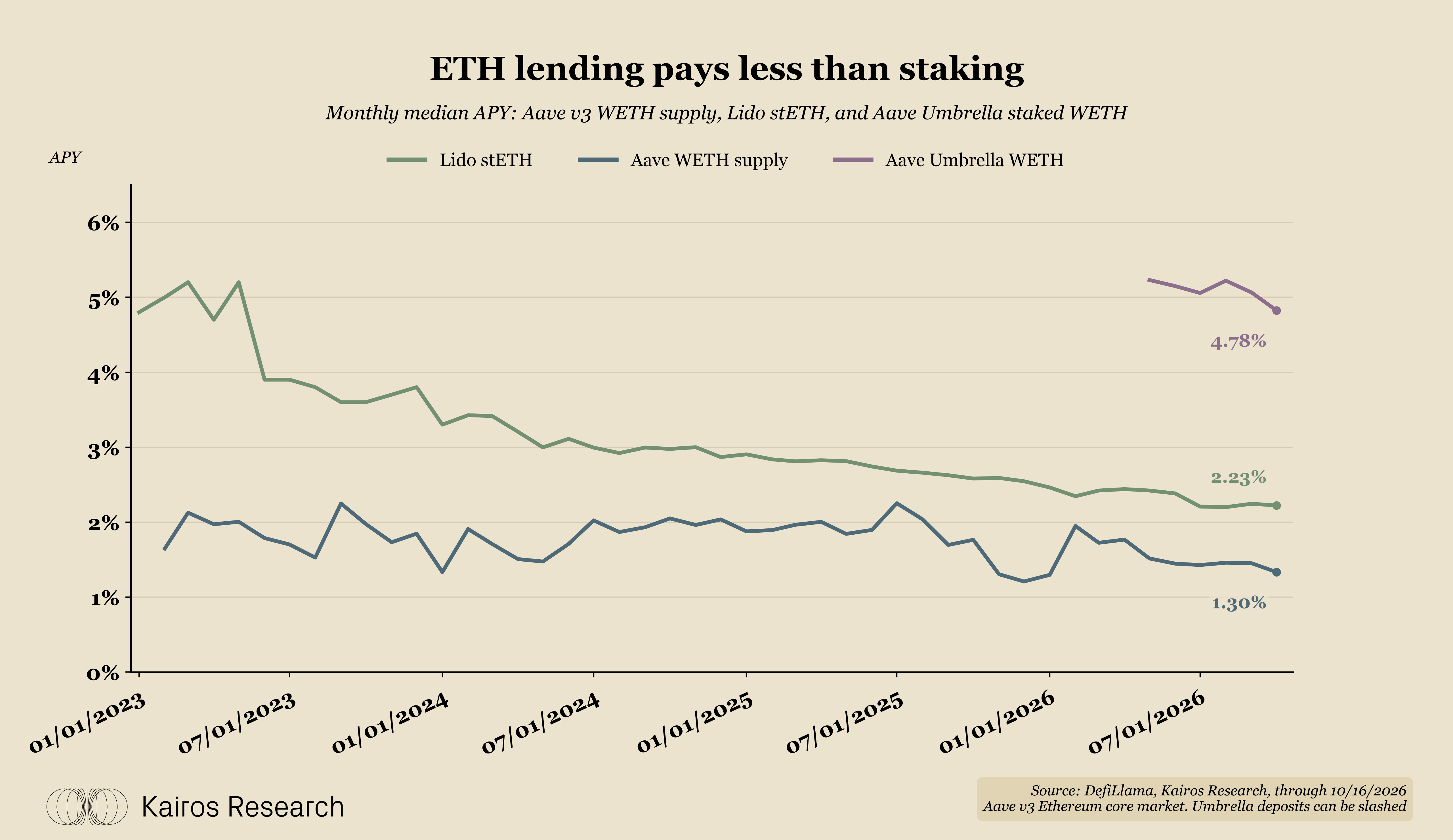
Lending WETH on Aave pays 1.3% today (1.7% average in 2026), about 0.9 points less than staking the same ETH.
Aave Umbrella pays 4.8% on WETH, but deposits can be slashed to cover bad debt, so the extra yield is premium for first-loss risk.
Covered calls
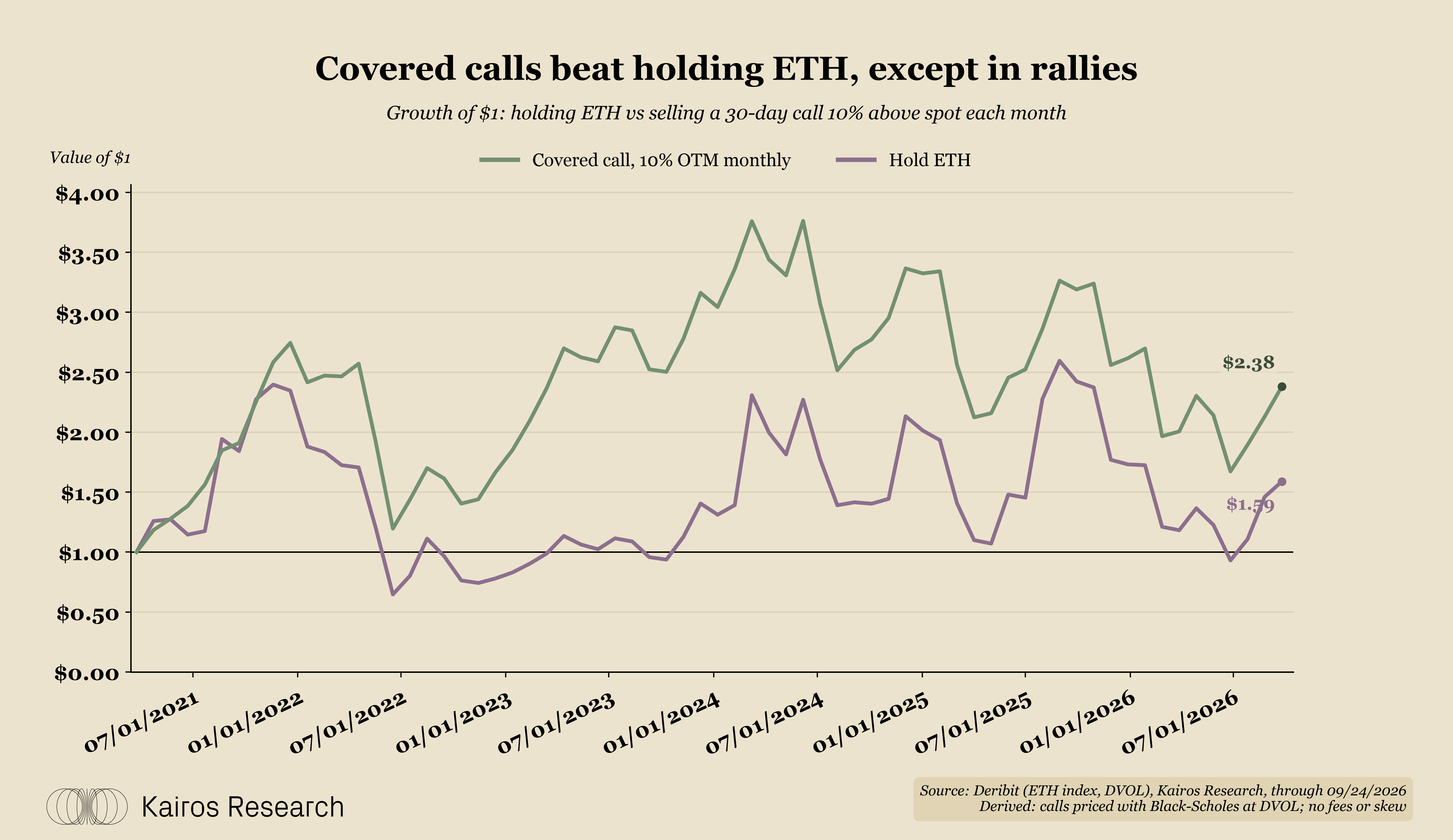
Today a 42-day call 10% above spot pays 3.2% of the ETH held. ETH implied volatility is 51, below every yearly average since 2021, so premiums are cheap.
Selling monthly 10% OTM calls since 2021 returned 17.1% a year measured in USD, vs 8.8% for holding ETH, but lagged badly in rallies (2024: +9% vs +53%).
Part 4: The Tradeoffs
Every step beyond staking adds risk somewhere. The right mix depends on how much ETH a treasury may need to sell in the next 12 to 24 months, and how much it can afford to lose.
Liquid staking: depeg risk and exit queues can make the benefits unattractive
Lending: smart contract, liquidity and bad debt risk
Restaking: slashing tied to outside services, and thinner exit liquidity for restaking tokens
First-loss cover: solvency and bad debt risk
Covered calls: upside is capped, and some options venues add counterparty risk
Basis trade: exchange counterparty risk, and funding that turned negative in 16% to 18% of hours over the past year
Across all of them, security is now the largest single concern.
Security is a real cost
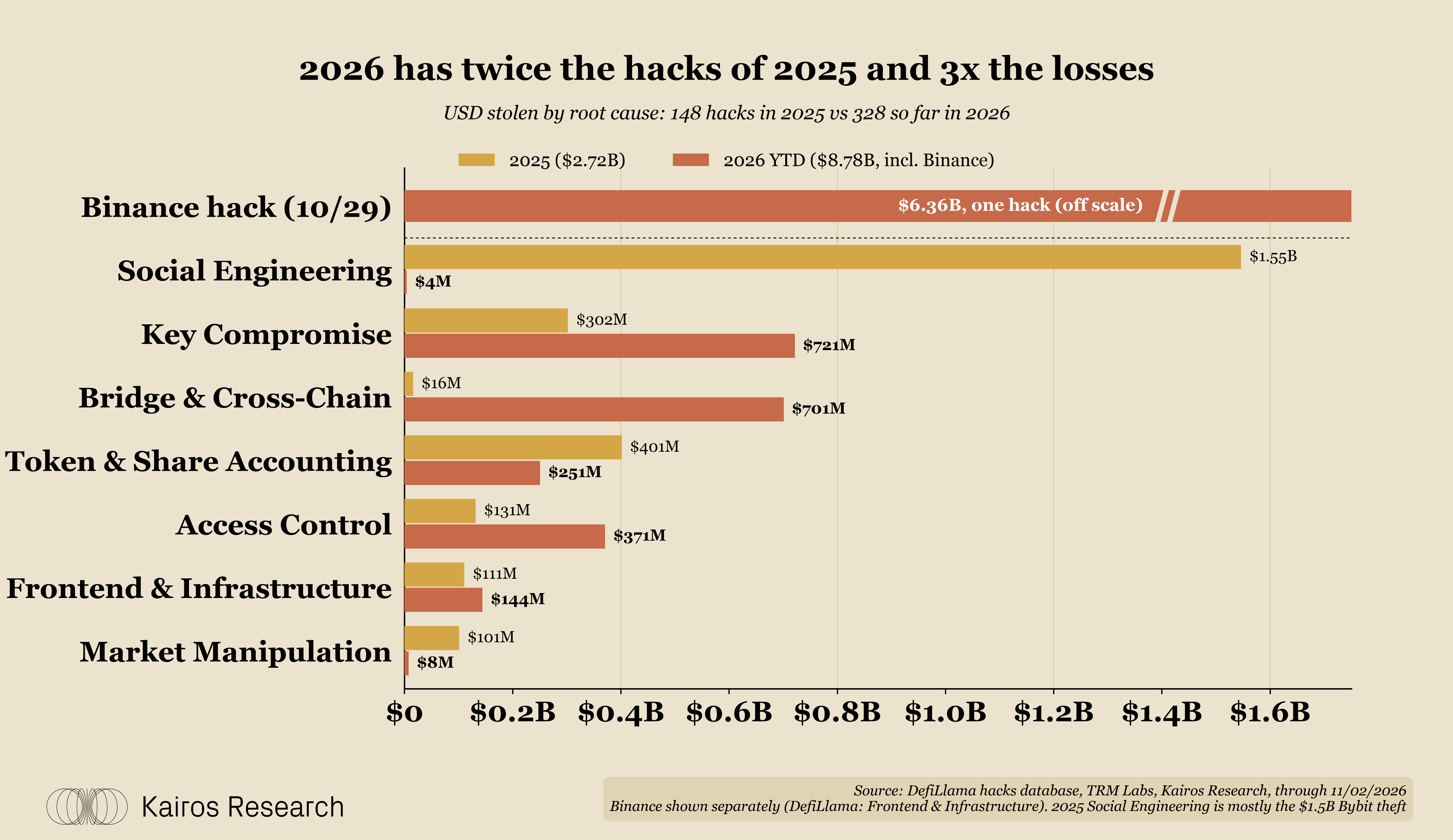
328 hacks so far in 2026 vs 148 in all of 2025, with $8.78B stolen vs $2.72B. Binance alone lost about $6.36B on 10/29/2026, the largest crypto theft on record, after attackers compromised its hot wallet signing infrastructure.
Excluding Binance, key compromise and bridge exploits each lost about $700M.
Part 5: Holding ETH When Your Bills Are in USD
Most treasuries pay salaries and vendors in dollars, so holding ETH is also a currency position. The range of outcomes is wide: a strong year can fund a decade of runway, and a weak one can cut it in half.
Best, worst and median years
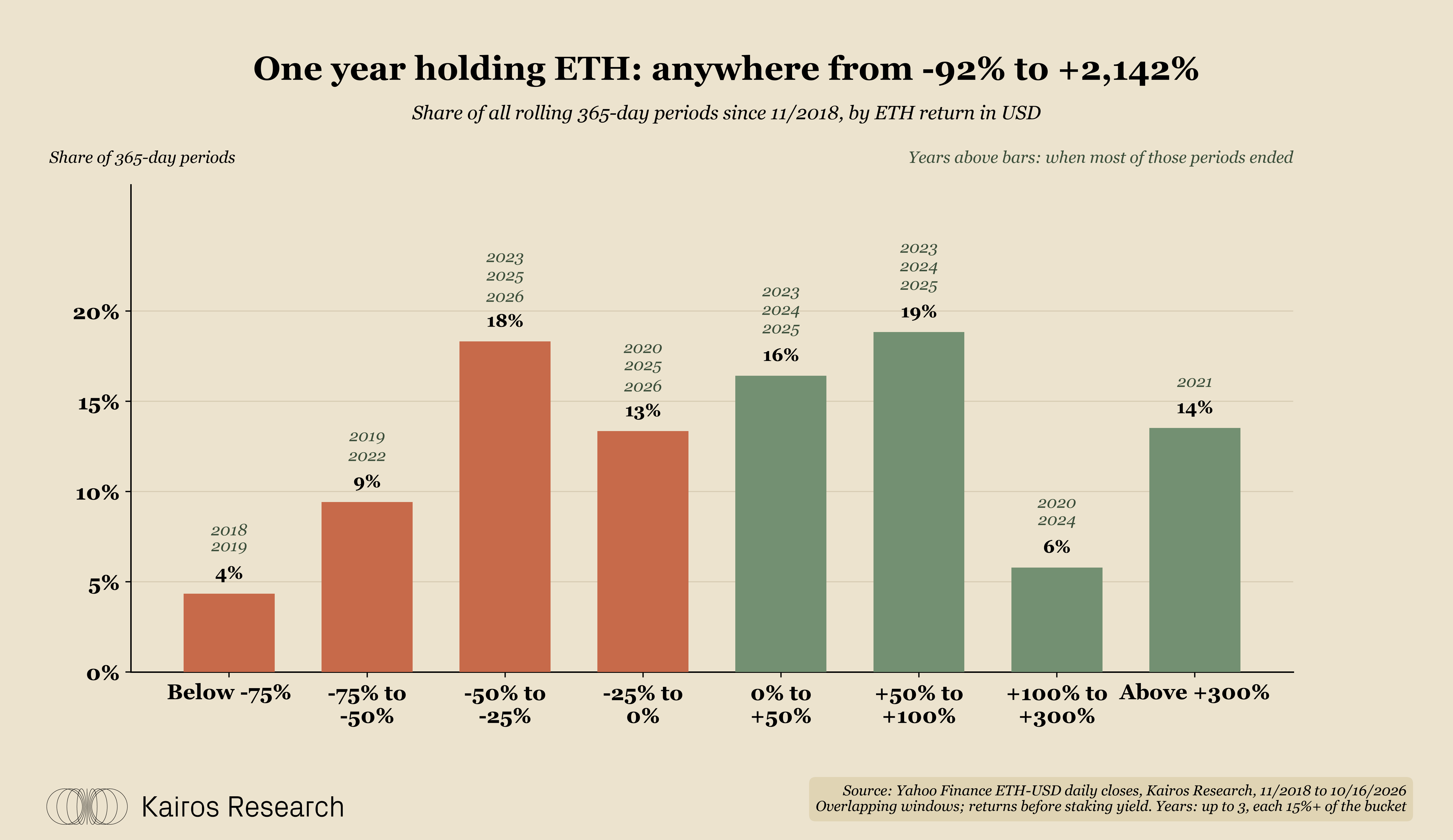
Since November 2018, a year of holding ETH returned anywhere from -92% to +2,142%. The median was +14%; 45% of one-year periods lost money and 14% lost more than half.
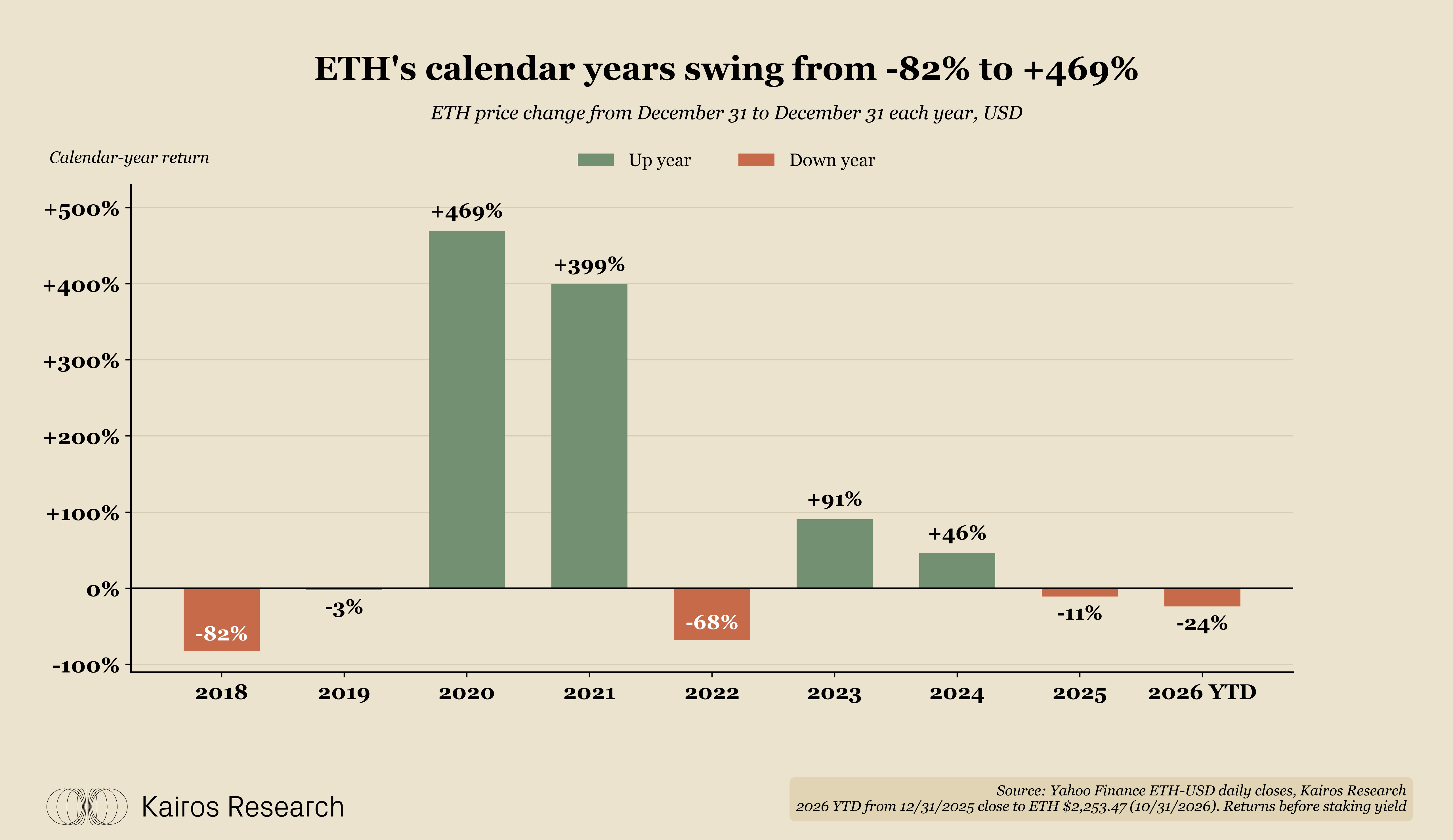
Over the past year, staked ETH earned +2.4% measured in ETH but lost 36.8% measured in USD. ETH treasuries need an ETH-denominated scorecard.
Volatility
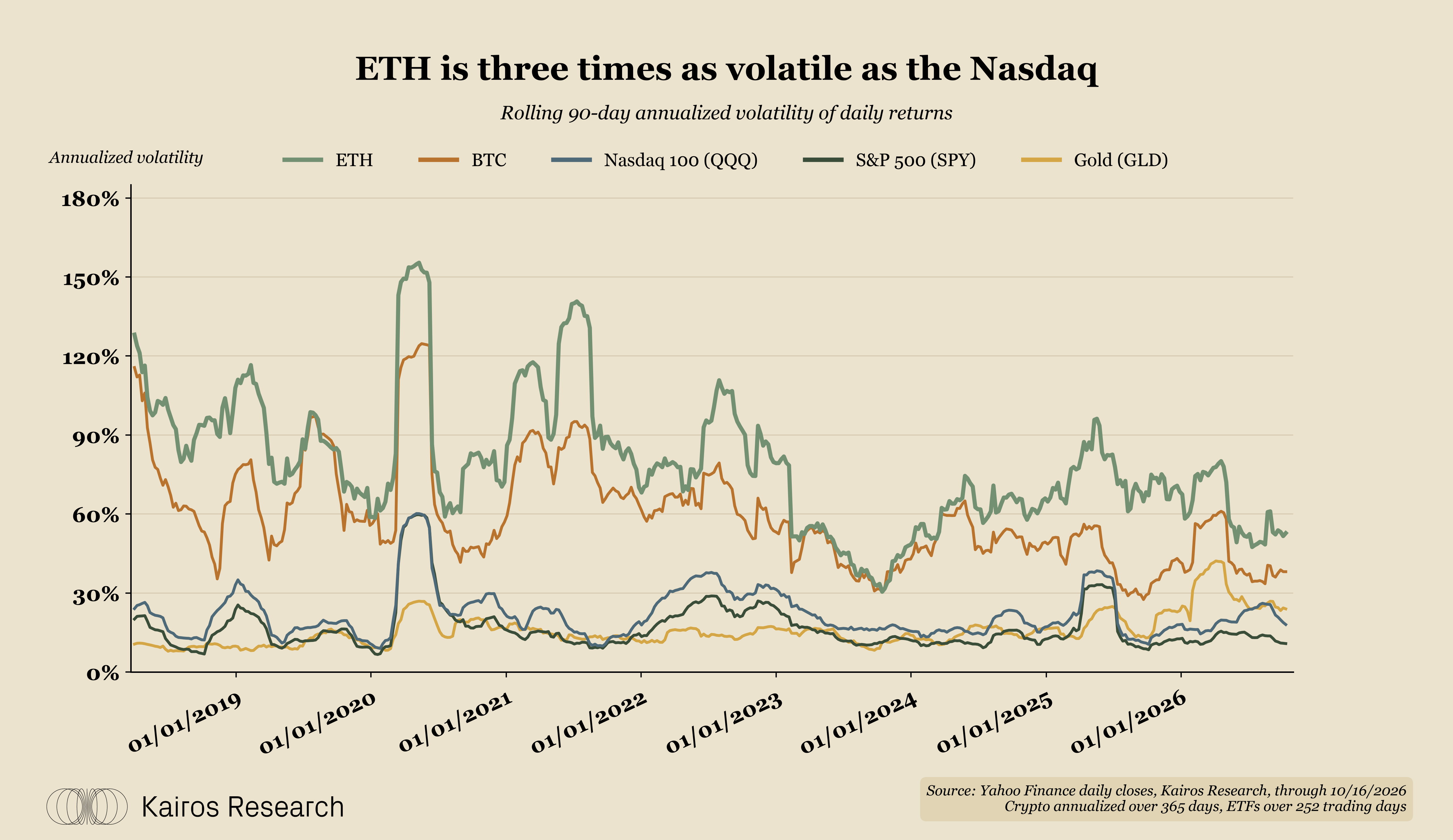
ETH’s volatility was 61% over the past year: 1.4x Bitcoin, 3.1x the Nasdaq 100, 4.8x the S&P 500 and 2.1x gold.
ETH moved more than 5% in a day on 19% of days since 2018, vs about 1% of days for QQQ and SPY.
Is ETH maturing?
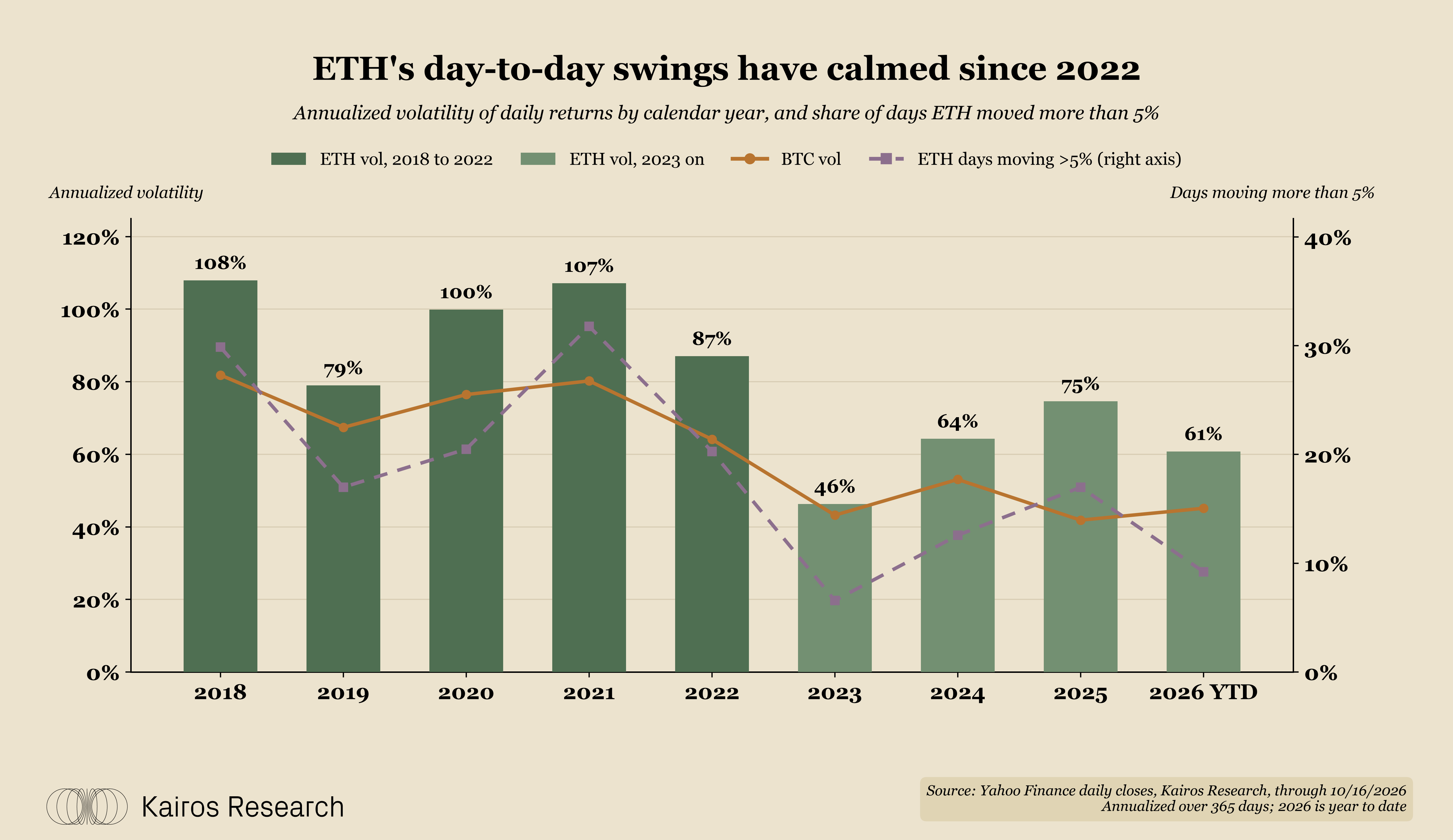
ETH’s volatility averaged about 96% a year from 2018 to 2022 and about 62% since 2023, and the share of days moving more than 5% dropped from between 17% and 32% each year to between 7% and 17%. Its swings have calmed as the asset matured and its holder base broadened.
ETH still fell 68% from its 08/2025 high to its 06/25/2026 low, and in 2025 its volatility was 1.8x Bitcoin’s, the widest gap since 2018, so treasuries should still plan for a deep drawdown each cycle.
ETH vs other major L1 tokens: drawdowns
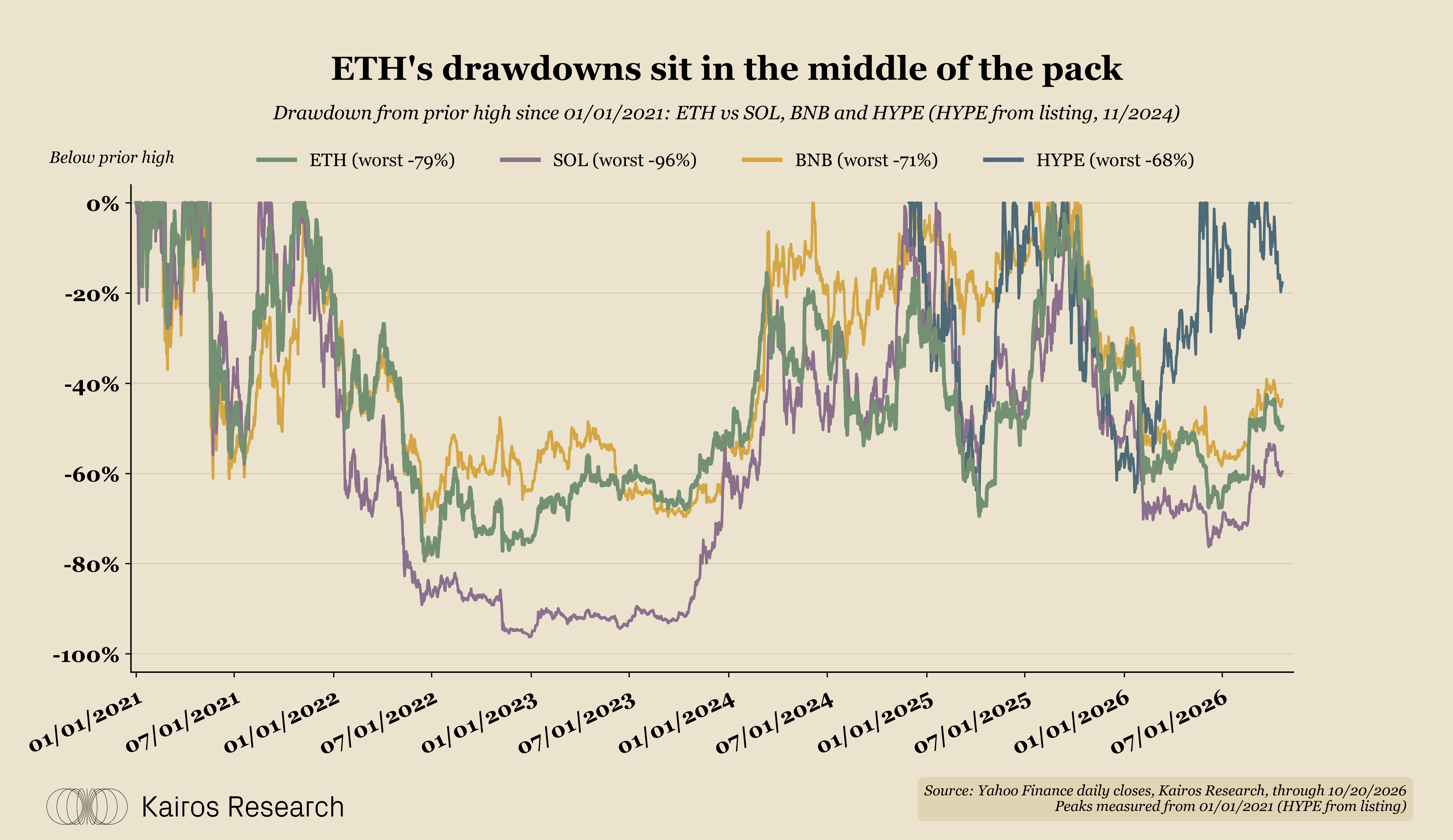
Since 2021, ETH’s worst drawdown was 79%, vs 96% for SOL and 71% for BNB. HYPE, listed in November 2024, fell as much as 68%.
As of 10/20/2026, ETH sits 50% below its high, SOL 60% and BNB 44%. HYPE is 18% below its 09/2026 high.
ETH vs other major L1 tokens: volatility
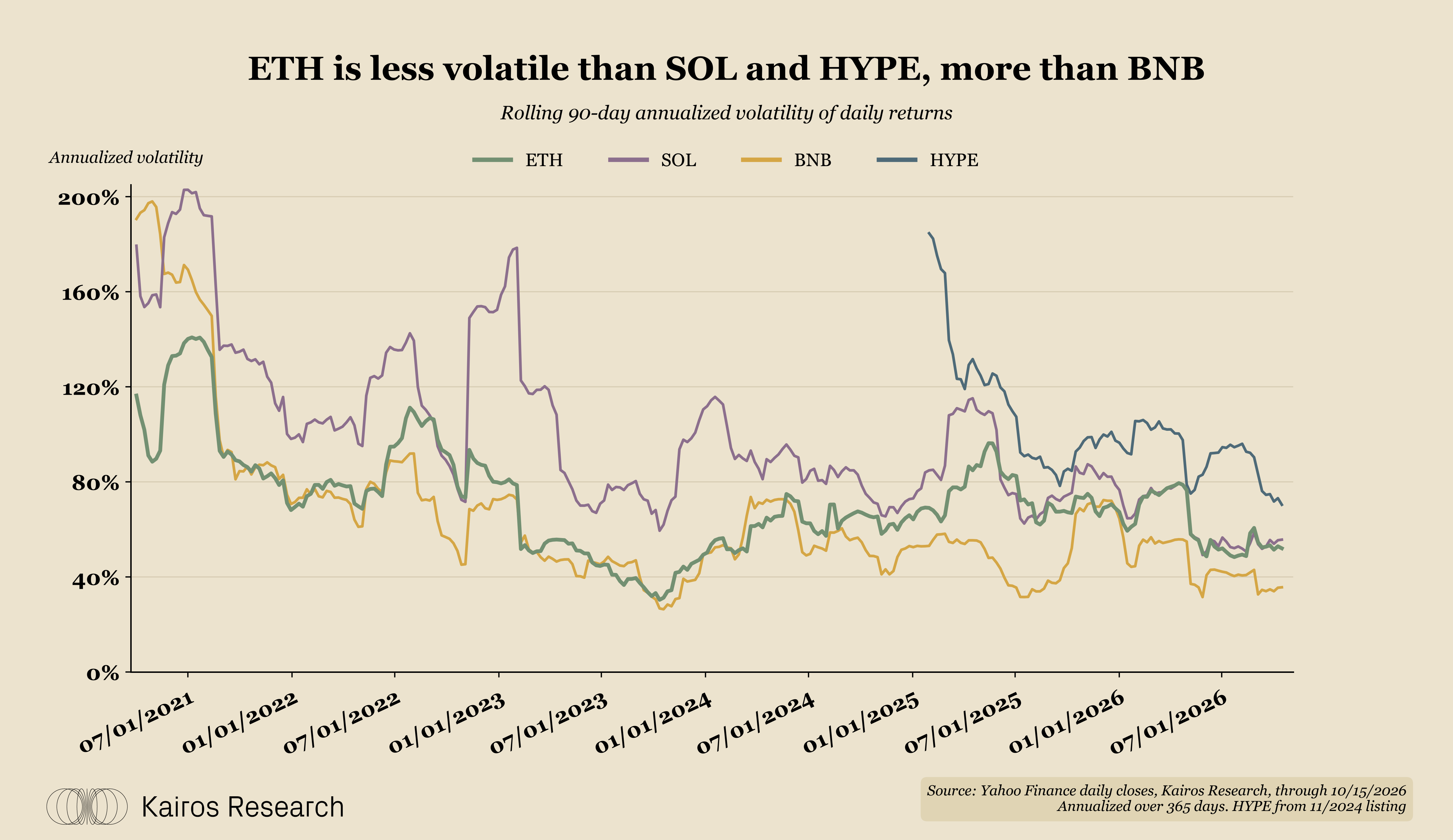
Over the past year, ETH’s volatility was 61%, vs 64% for SOL, 45% for BNB and 90% for HYPE.
Since 2025, volatility ran 69% for ETH, 76% for SOL, 49% for BNB and 98% for HYPE.
Part 6: The Stablecoin Comparison
Dollars held onchain can earn more than T-bills, through strategies like lending, basis, reinsurance and GPU-backed credit. These rates are the comparison point for any ETH strategy, and a sign of how much yield onchain apps now pass directly to their users. They are also falling as subsidies dry up and more capital arrives.
Onchain dollar yields
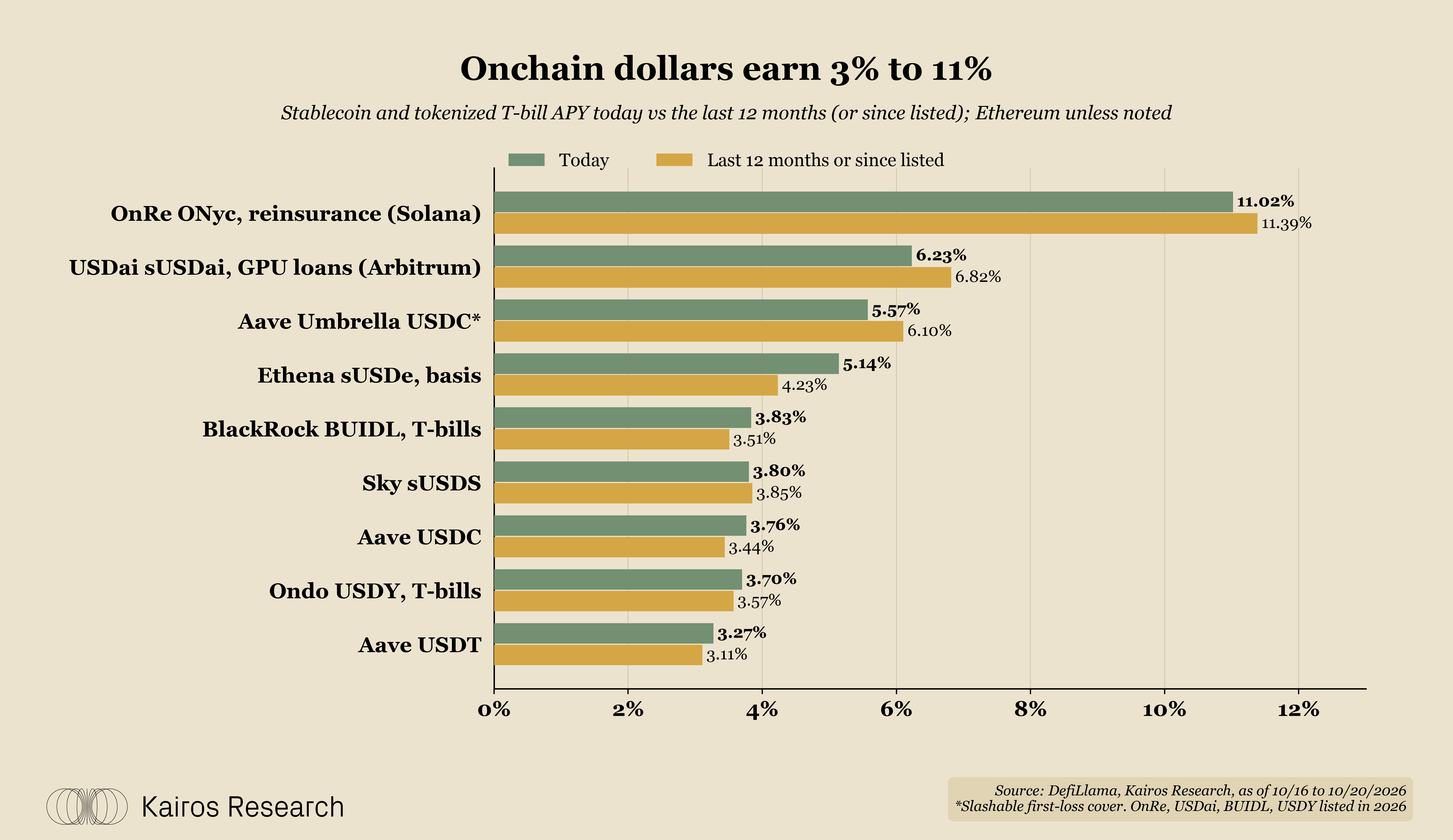
Rates run from 3.3% (Aave USDT) to 11.0% (OnRe reinsurance, on Solana), with tokenized T-bills from BlackRock and Ondo at 3.7% to 3.8%. USDai’s GPU-backed loans pay 6.2% on Arbitrum.
Aave pays 3.8% on USDC and 3.3% on USDT, about half its 2024 averages of 7.2% and 6.3%. sUSDe pays 5.1% but ranged 0.1% to 5.7% over the past year, with a 7-day unstake.
The basis trade has compressed
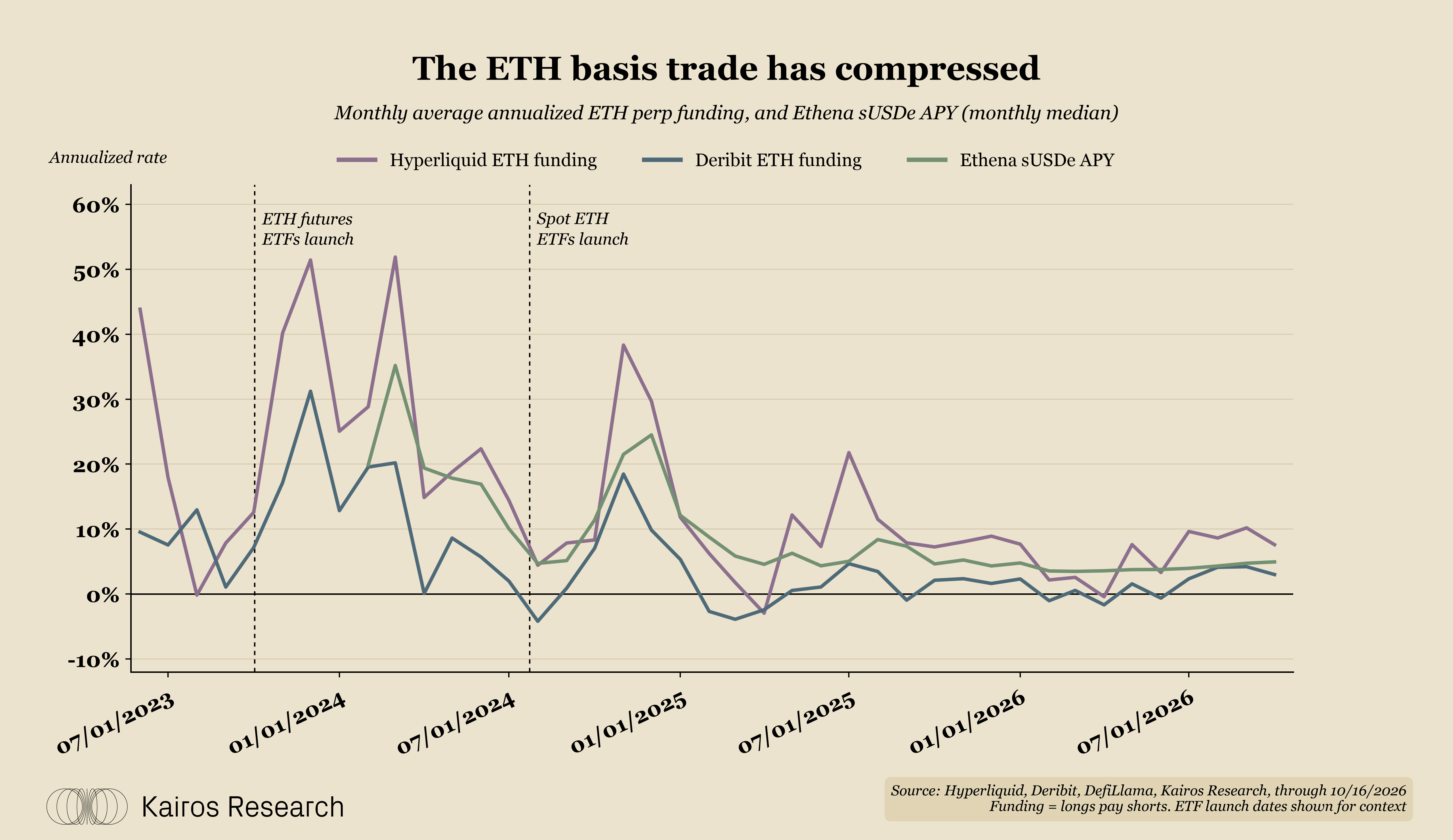
Hyperliquid ETH funding fell from 22% in 2023 and 2024 to 5.9% in 2026, and sUSDe fell from 17.5% to 4.2% as capital crowded into the trade. Part of the compression lined up with ETH futures ETFs (10/2023) and spot ETH ETFs (07/2024), which gave basis traders new venues.
Funding was negative in 16% to 18% of hours over the past year. Deribit dated futures lock in 4.3% to 4.7% annualized today.
Part 7: Holder Perspectives
Parts 1 through 6 draw on public market and onchain data. This final section turns to the thesis behind the largest ETH holders: what they expect to drive demand for ETH, and what the data says so far. We have surveyed and taken publicly available statements from treasury companies, brokerages, service providers and asset managers in the space.
The ETH treasury thesis
Treasury companies argue that demand for ETH will follow the assets moving onchain. Bitmine chairman Tom Lee frames Ethereum as the settlement layer for stablecoins and tokenized assets. The data below tests three parts of that thesis:
Stablecoins: does supply growth on Ethereum translate into fees paid and ETH held?
Tokenized equities and RWAs: which chain issuers choose, and why.
L2s as distribution: Robinhood Chain uses ETH as gas and settles to Ethereum.
Stablecoin growth and Ethereum’s share
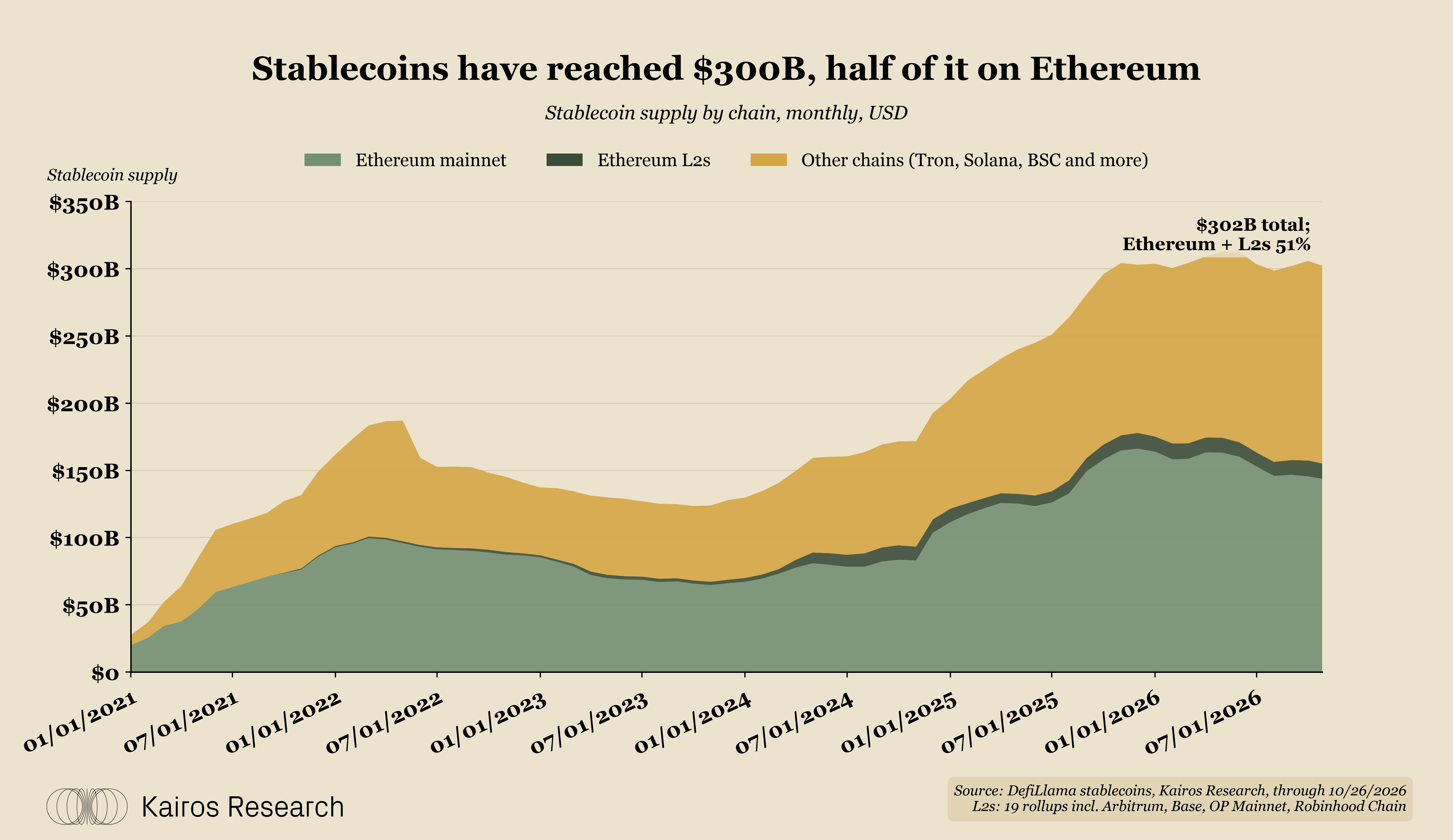
Stablecoin supply has grown from $27B in 01/2021 to $302B today, adding about $100B since 01/2025.
Ethereum and its L2s hold 51%.
Tokenized stocks
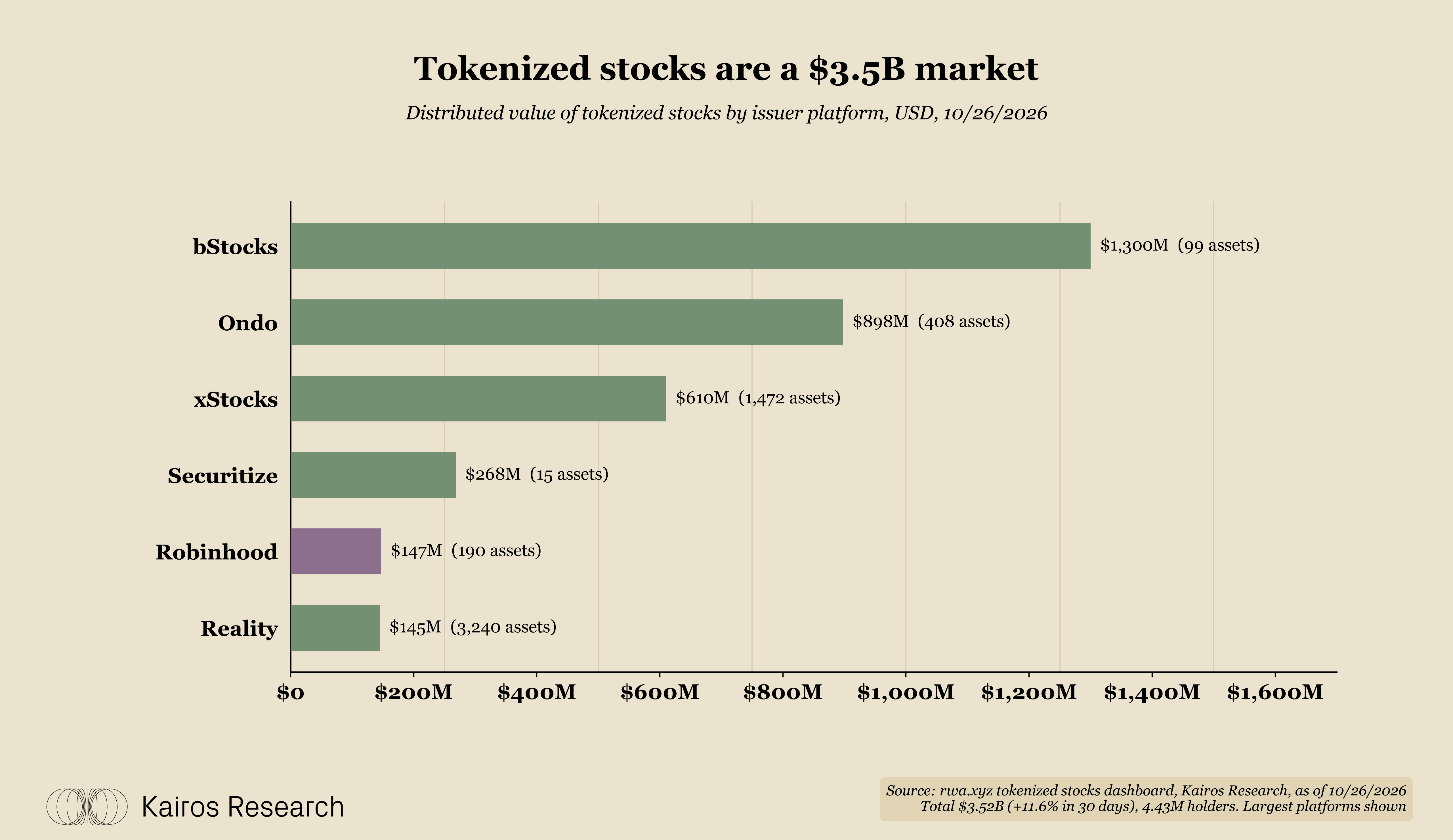
Tokenized stocks reached $3.52B on 10/26/2026, up 11.6% in 30 days, with 4.43M holders.
bStocks, Ondo and xStocks lead across several chains; Robinhood has issued $147M across 190 stocks.
ETH on Robinhood Chain
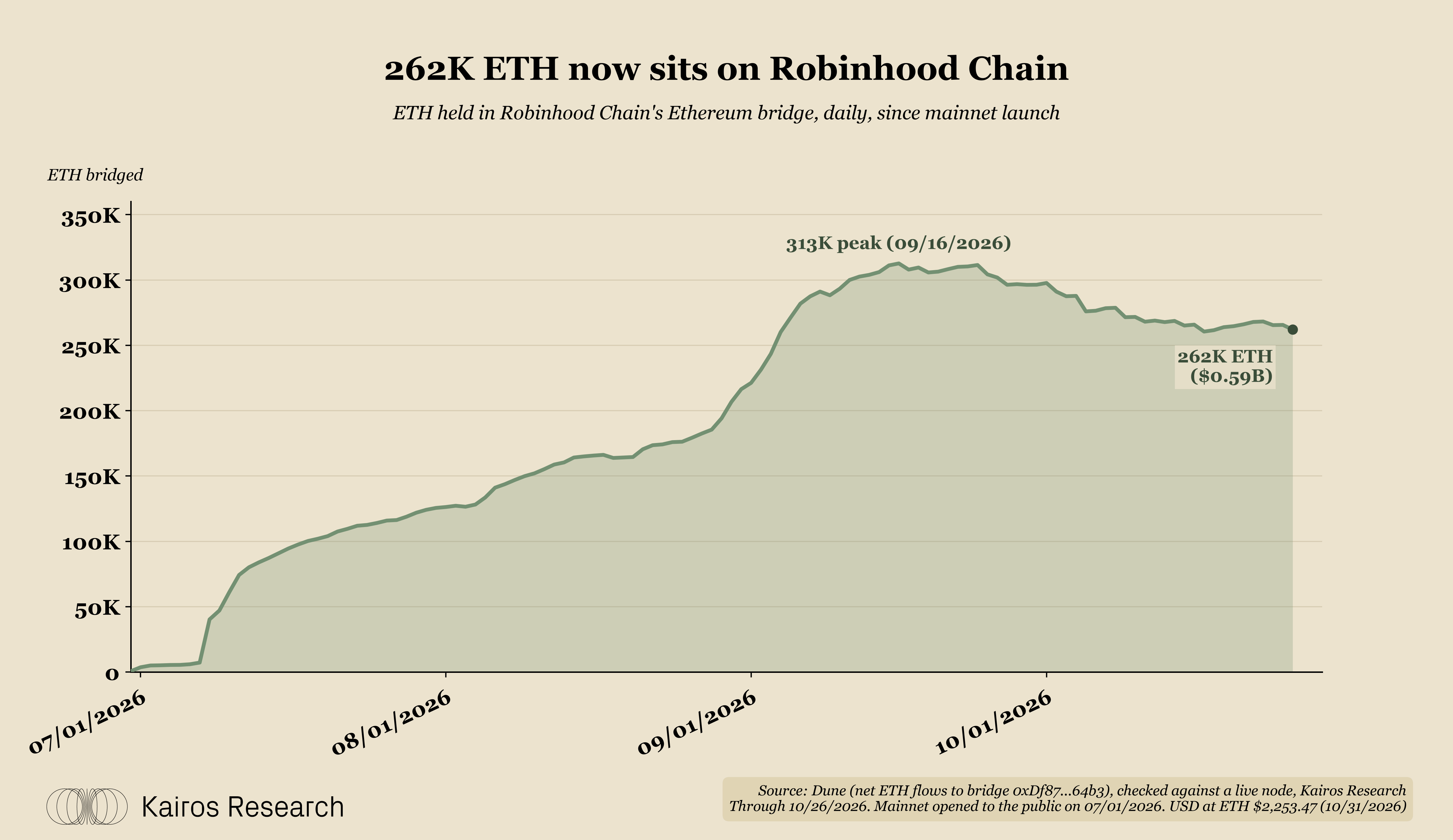
262K ETH ($590M) sits in Robinhood Chain’s bridge, up from under 1K before its 07/01/2026 public launch, after peaking at 313K on 09/16.
Robinhood Chain uses ETH as its gas token, so every user who trades there needs to hold ETH: a direct example of an app creating demand for the asset.
Robinhood Chain sequencer revenue vs Ethereum costs
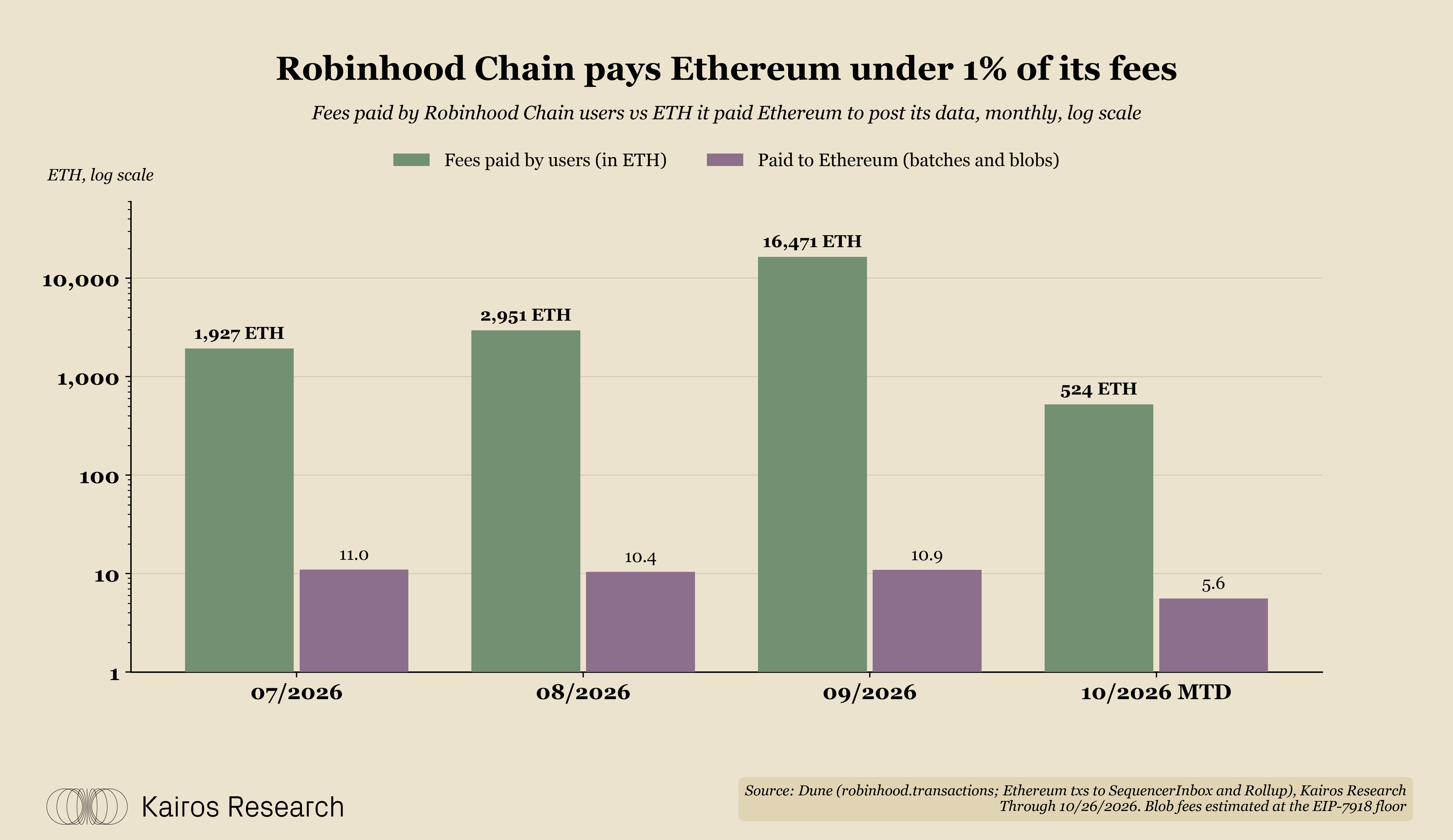
Users have paid about 21,900 ETH in fees since July.
For now, Ethereum captures value mainly through ETH used as gas and held on the chain (as seen above), not through settlement fees. Ethereum likely can expand its take from L2s in the long run.
The above data showcases a number of clearly positive trends taking place on Ethereum and in crypto more generally. So for the market participants looking to place their bets on ETH, what is the best way for them to participate?
Staking is where most ETH treasuries look to start, but with compressing yields it is no longer the whole answer. Yields have halved to 2.2% since 2022. Restaking hasn’t filled the gap, and in ETH terms, lending and LPing pay less than staking does. The only strategies that clearly beat the baseline, first-loss cover and covered calls, do it by taking on real risk or limiting upside. As we have seen with several onchain protocols multiple times in the past year, there is real risk in being the first line of defense. The service providers we surveyed agreed on this. Every one of them marked staking yield “a base, but not enough on its own.”
They also noted that internal governance is what is holding most ETH treasuries back from putting their assets to use onchain. Respondents named smart contract risk, board approval and a lack of clear standards as the main blockers. However, most said board or regulatory comfort would do more to unlock deployment than a higher yield would.
Some of the largest holders don’t stake at all, whether because of an ETF mandate or because staking is still a regulatory gray area in places like Korea. With an increasing amount of exploits and hacks so far in 2026, caution is more than reasonable. However, as the market matures our survey respondents and participants are seeing favorable trends. Joshua Lim, Global Co-Head of Markets at FalconX, and Kam Benbrik, Head of Onchain Research at Bitwise, both highlighted the increase in activity and mindshare in the RWA space:
“In 2027, people will ask less about how to tokenize an asset and more about what they can do with it once it’s tokenized. Services traditionally offered by prime brokers, such as financing and collateral management, could become more accessible onchain. This creates an opportunity to lower barriers to entry and open these services to a wider range of investors.”
Kam Benbrik, Head of Onchain Research, Bitwise
“The growth of activity in RWA instruments on-chain across perps and spot was a key trend throughout the year. For 2027, we look forward to further supporting these markets for our clients.”
Joshua Lim, Global Co-Head of Markets, FalconX
Innovation and availability have opened up the investable world for crypto participants. Charles d’Haussy, CEO of the dYdX Foundation, noted that “Better availability of RWAs at qualified custodians and traditional finance banks, along with improved distribution, allowed us to meaningfully increase our exposure to tokenized assets.”
So while it will take time for the regulatory clarity and onchain security improvements needed for board comfort to play out, a big question for 2027 is whether the thesis behind holding ETH plays out. Treasury companies are betting that demand for ETH will follow the assets moving onchain, and we are seeing just that:
Stablecoins have shown persistent growth through several different market environments
Robinhood, one of the world’s most popular brokerages, rolled out onchain stocks via an Ethereum L2
Unique primitives like OnRe, USDai and Ethena’s tokenized basis trade have showcased the demand for yield opportunities onchain
Sources
Bitmine and Sharplink
Bitmine holdings release, 10/26/2026 (6.05M ETH, 5.23M staked, 2.58% yield, $318M guidance)
Bitmine acquires Pier Two to launch MAVAN (Seeking Alpha)
Pier Two joins MAVAN (Lido research forum)
Bitmine staking was 98% of quarterly revenue (The Block)
Bitmine’s native staking onchain (Arkham research)
Bitmine staking passes 70% of holdings (The Block)
Sharplink Q2 2026 results: holdings split and $76.1M impairment (Cointelegraph)
Sharplink $200M Linea deployment via ether.fi and EigenCloud (press release)
Sharplink deploys $170M on Linea (The Block)
Sharplink $200M Lido allocation (press release)
Sharplink activates $400M onchain (Coingape)
Galaxy Sharplink Onchain Yield Fund (Galaxy)
Sharplink cumulative staking rewards, 09/29/2026
Ethereum treasury holdings trackers (CoinGecko, Strategic ETH Reserve)
Ethereum Foundation wallets and validators: Kairos onchain count, 11/02/2026
ENS Endowment: kpk monthly community update, September 2026
GnosisDAO treasury dashboard (gno.now), 11/02/2026
Mantle treasury page and Treasury Monitor (group.mantle.xyz/treasury, treasurymonitor.mantle.xyz), 11/03/2026
Lido GOOSE-2026 H1 report; Lido DAO Agent and reserve fund, onchain 11/02/2026
Arbitrum DAO treasury portfolio (arbdata.com, Entropy Advisors), 11/02/2026
Market and onchain data
DefiLlama: yields, treasuries, stablecoins, protocols, hacks
TRM Labs: Binance hack, 10/29/2026 ($6.36B)
Dune: staked ETH, Golem Foundation wallets, Robinhood Chain fees and bridge queries (Kairos)
Arkham Intelligence: entity labels and holdings
rwa.xyz: tokenized Treasuries and tokenized stocks
L2BEAT: Robinhood Chain contracts
Deribit, Hyperliquid and OKX market data; Yahoo Finance daily prices
About the Teams Behind This Report
Kairos Research is an independent, market-focused research firm, co-founded by Ian Unsworth and Teddy Oosterbaan.
Golem Foundation is an independent foundation with a mandate to strengthen GLM’s long-term value. We run our treasury in public: since 2023, its yield has funded all of our work with the principal intact, and we’re now diversifying beyond staking. Octant, which we built and operate, has directed more than 5,273 ETH of that yield to users and Ethereum’s most impactful teams.
Ethereum Institutional is an independent non-profit dedicated to accelerating the institutional adoption of Ethereum, its L2s, applications and overall ecosystem.
Participation and disclosures
Quotes in this report were received directly from teams at KODA, FalconX, Bitwise, Sharplink, Bitmine and the dYdX Foundation. Sharplink provided limited clarifications and corrections to publicly available information used in preparing this report, along with a response to one question from its CEO, Joseph Chalom. Onchain data comes from Dune and DefiLlama; market data from Deribit, Hyperliquid and Yahoo Finance. This report is meant for research and analysis, not investment advice.